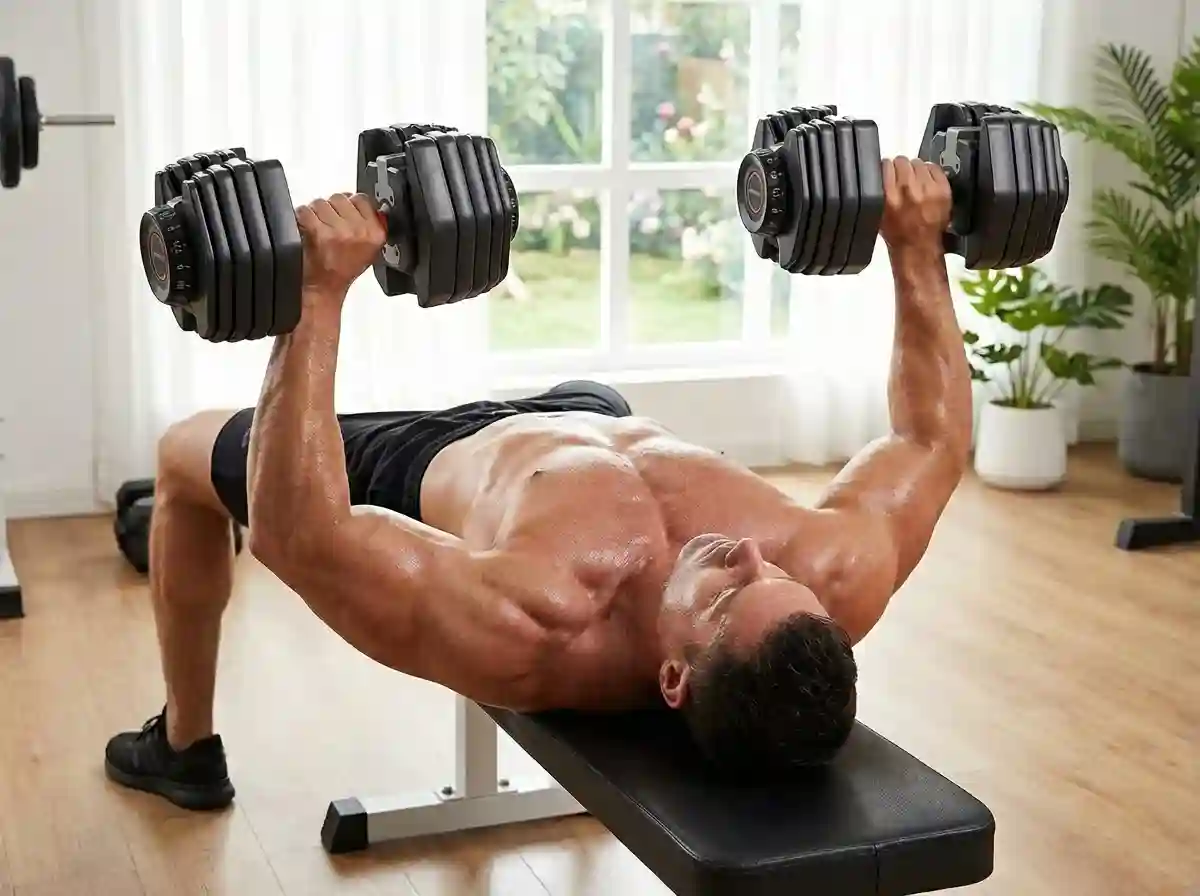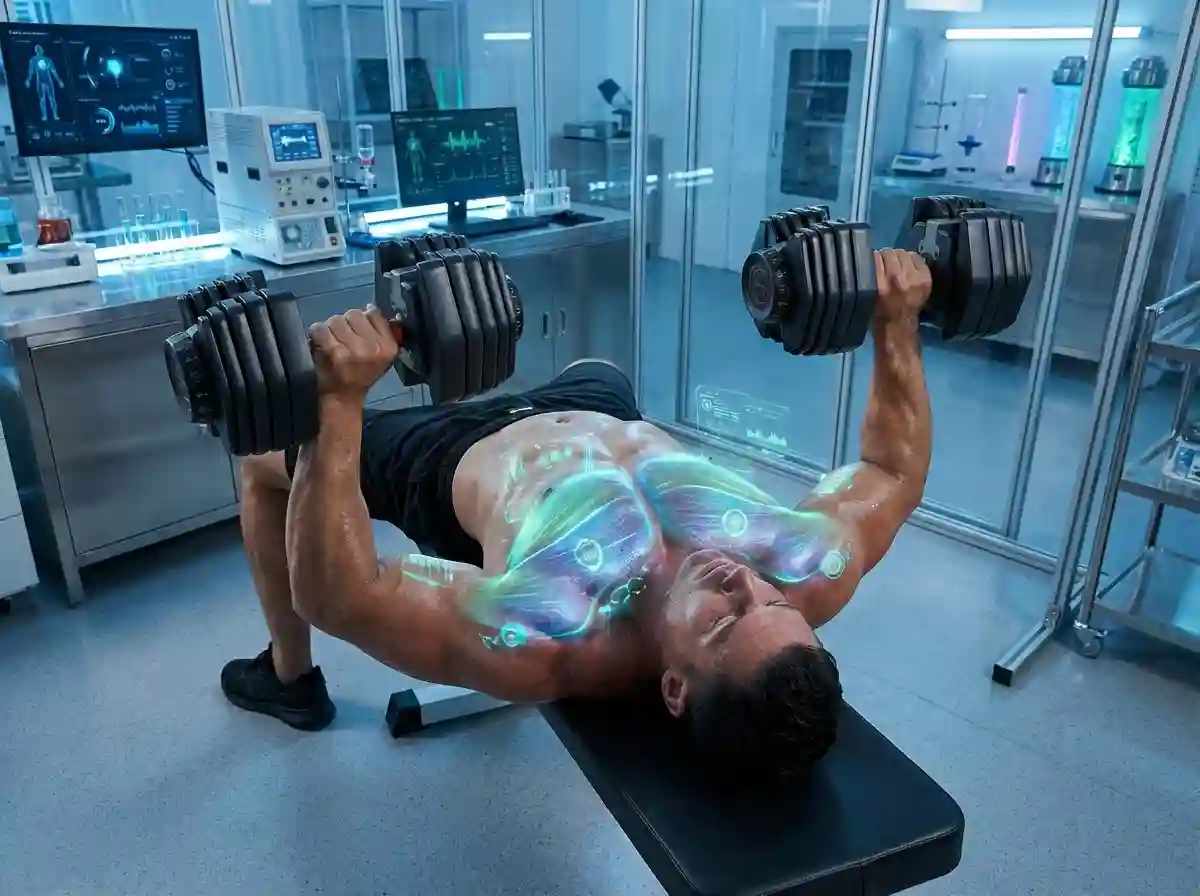
Let's start with something most gym-goers don't know: when researchers strap EMG sensors to your chest and make you bench press, the results are genuinely surprising. The pectoralis major — the muscle everyone is trying to grow — often fires just as hard with dumbbells as with a barbell, despite lifting 15–20% less weight. That single finding reshapes the entire conversation.
This article walks through the actual peer-reviewed data: muscle activation numbers, load comparisons, what happens to your triceps and biceps in each variation, and what all of it means for how you should program your training. No bro-science. No oversimplified take. Just what the research shows and how to use it.
The Load Gap Is Real — and Smaller Than It Feels
The most commonly cited study on this question is Saeterbakken et al. (2011), published in the Journal of Human Kinetics. Twelve resistance-trained men performed 1-rep max testing on three pressing variations:
| Exercise | Average 1RM | vs. Barbell | Effect Size |
|---|---|---|---|
| Barbell Bench Press | 100.3 ± 15.6 kg | Reference | — |
| Smith Machine Press | 97.4 ± 14.5 kg | –2.9% | 0.18 (trivial) |
| Dumbbell Bench Press | 83.2 ± 13.8 kg | –17.1% | 1.11 (large) |
Seventeen percent is a meaningful gap. But the reason behind it matters more than the number itself. It's not that dumbbells are less effective — it's that your nervous system redirects effort toward stabilization when the load becomes independent and three-dimensional. Researchers call this the stability-force trade-off: the more your neuromuscular system has to spend on controlling where the weights are going, the less it can allocate to raw force production.
The ~17% load deficit with dumbbells is not a training deficit. It reflects redirected neural resources. The chest often receives an equivalent or greater stimulus despite the lower absolute load.
Chest Activation: The Counterintuitive Part
Despite moving significantly less weight, the dumbbell bench press frequently produces equivalent or superior pectoralis major activation compared to the barbell. This has been replicated across multiple independent research groups:
| Study | Pec Major Result |
|---|---|
| Saeterbakken et al., 2011 (1RM) | No significant difference |
| Welsch et al., 2005 (6RM) | No significant difference |
| Farias et al., 2017 (10RM × 4 sets) | Dumbbells significantly higher |
Farias et al. (2017) had 19 resistance-trained men perform 4 sets of 10RM across all three pressing variations. Over those multiple sets, the accumulated advantage of the dumbbell's greater range of motion and peak-contraction opportunity became measurable in the EMG signal. By the later sets, the pectoralis major was working statistically harder in the dumbbell condition — despite the lower load.
The mechanism is straightforward: with a barbell, the bar meets your chest and that's it — a hard stop. Dumbbells can be lowered past the torso, creating a deeper eccentric stretch, and on the way up they can converge at the top, aligning more naturally with the pectoralis major's actual line of pull. That peak contraction adds up, especially across multiple working sets.
The Synergist Story: Triceps, Biceps, and What Each Exercise Actually Trains
Where the two exercises genuinely differ is in how the supporting muscles behave. This is where each tool starts to earn its distinct role in a program.
Triceps: The Barbell's Strong Suit
Both the Saeterbakken and Farias studies found significantly higher triceps brachii activation during the barbell bench press (p = 0.007 in Saeterbakken). The mechanism is partly mechanical: with a barbell, you can apply a lateral force through the bar — the cue to "try to pull the bar apart" — which drives additional elbow-extensor recruitment. With dumbbells, the triceps' job is more about keeping the weights vertical than driving the final lockout phase.
Biceps: The Surprise Activation in Dumbbells
The most striking finding in the stability literature involves the biceps brachii. In a Smith machine, biceps activation is essentially zero. In the barbell bench press, it's minimal. With dumbbells, it jumps significantly. Saeterbakken et al. reported a statistically significant increase across all three conditions (Smith < Barbell < Dumbbells, p ≤ 0.005). The long head of the biceps is a dynamic stabilizer of the glenohumeral joint — it contracts to prevent anterior migration of the humeral head.
| Muscle | Higher Activation | Why |
|---|---|---|
| Pectoralis Major | Dumbbells (often) | Deeper eccentric stretch, peak contraction at top, ROM advantage |
| Triceps Brachii | Barbell | Lateral force vectors on fixed bar, hard lockout under load |
| Anterior Deltoid | Equal | Shoulder flexion function consistent across both |
| Biceps Brachii | Dumbbells | Dynamic glenohumeral stabilization with independent loads |
| Rotator Cuff | Dumbbells | Multi-plane stability demands activate shoulder stabilizers |
What Changes When You Adjust Bench Angle and Grip
A study by Rodríguez-Ridao et al. (2020) tested activation across five different incline angles in 30 trained adults:
| Bench Angle | Upper Chest (%MVIC) | Best For |
|---|---|---|
| 0° (flat) | ~49% | Overall chest mass, sternocostal head |
| 15–30° (low incline) | ~55% (peak) | Upper chest — the optimal range |
| 45° (moderate incline) | Moderate, decreasing | Transition zone — less pec, more delt |
| 60° (steep incline) | Low | Anterior deltoid dominant — minimal chest |
Grip width follows similar logic: wide grip increases pectoral stretch, narrow grip shifts load toward the triceps and the clavicular head — useful if you want to bias the upper chest on a flat bench.
The Case for Each — and Why Neither Is "Better"
The honest framing is that the barbell and dumbbell bench press aren't competing for the same job. They have genuinely different strengths, and a well-designed program uses both.
For maximal strength: The barbell is the correct choice. It allows more total load, better progressive overload tracking, and maximal triceps co-activation. If your goal is a bigger 1RM or you compete in powerlifting, the barbell is not optional.
For hypertrophy and symmetry: The dumbbell's advantages accumulate over a training cycle. The deeper ROM means greater mechanical tension on the stretched pec. The independent loads force each side to work equally — preventing the dominant side from masking a strength imbalance.
A Practical Note on Periodization
Some coaches use an "undulating" approach: 4–6 week blocks of barbell-emphasis followed by dumbbell-emphasis. The rationale isn't complicated — the nervous system adapts to whatever stress you repeatedly impose, and switching implements forces a genuine reorganization of motor unit recruitment.
A lifter stuck on a barbell plateau often responds well to a dumbbell block, not because dumbbells are better, but because the neural pattern is different enough to break accommodation. In practice, the most effective arrangement is heavy barbell pressing early in the session (CNS fresh), followed by dumbbell work in the 8–15 rep range to accumulate volume.
| Training Goal | Recommended Tool | Rationale |
|---|---|---|
| Maximal strength / powerlifting | Barbell | Peak load capacity, triceps lockout, competition specificity |
| Muscle hypertrophy | Dumbbells | ROM advantage, peak contraction, unilateral balance |
| Shoulder rehab / joint health | Dumbbells | Independent path, stabilizer recruitment, pain-free ROM |
| Breaking a training plateau | Alternate blocks | Different neural pattern disrupts accommodation |
| General fitness / long-term programming | Both | Complementary tools, not competing ones |
The Shoulder Angle Question
There's a clinical dimension that rarely gets attention in gym-focused content. Orthopedic therapists increasingly prefer dumbbell pressing with rehabilitation patients — not primarily because of the EMG data, but because each shoulder can move independently along its natural arc.
With a barbell, your hands are locked into a fixed position. If your shoulder mechanics are asymmetrical — which they are for most people who've trained one-sidedly for years — you're forced into a path that may not suit your anatomy. Dumbbells let each shoulder find its own pain-free trajectory. For people with previous anterior shoulder instability, labral issues, or longer-term training history that's produced muscle imbalances, this independence is clinically meaningful.
The existing EMG literature is mostly acute — it measures what happens during a single session, not over 12 or 24 months. We don't yet have rigorous longitudinal studies comparing long-term hypertrophic outcomes between exclusive barbell and exclusive dumbbell programs. Short-term activation patterns don't always predict long-term structural adaptation.
The bottom line is that the barbell/dumbbell debate has been framed as a competition when it's actually a collaboration. If you're only pressing with a barbell, you're likely leaving chest ROM, stabilizer development, and some insurance against imbalances on the table. If you're only pressing with dumbbells, you're probably undertaxing your triceps and limiting the load potential that drives maximal strength. The research doesn't give either implement a clean victory. It gives you a clearer picture of what each one actually does.
Sources
- Saeterbakken AH, van den Tillaar R, Fimland MS. (2011). Journal of Sports Sciences, 29(5), 533–538.
- Farias DA, et al. (2017). Journal of Strength and Conditioning Research, 31(7), 1879–1887.
- Welsch EA, Bird M, Mayhew JL. (2005). JSCR, 19(2), 449–452.
- Rodríguez-Ridao D, et al. (2020). Int. J. Environ. Res. Public Health, 17(19), 7339.
- Saeterbakken AH, Fimland MS. (2013). JSCR, 27(7), 1824–1831.
Train With the Right Equipment
FEIERDUN® adjustable dumbbells are designed for serious training — full range of motion, anti-slip grip, and professional build quality.