There's a reason serious coaches keep coming back to the kettlebell swing. Not because it's trendy — it was already old when your grandfather was lifting — but because when you look at the actual data, it does something few exercises can: it trains explosive power, posterior chain strength, and cardiovascular conditioning simultaneously, without eating up a full training session to do it.
This article digs into what's actually happening biomechanically when you pick up a kettlebell and swing it. Not the watered-down version. The real stuff — force plates, EMG data, spinal loading, and what separates someone who swings well from someone who's just moving the weight around.
It's a Hip Hinge, Not a Squat — and That Distinction Matters
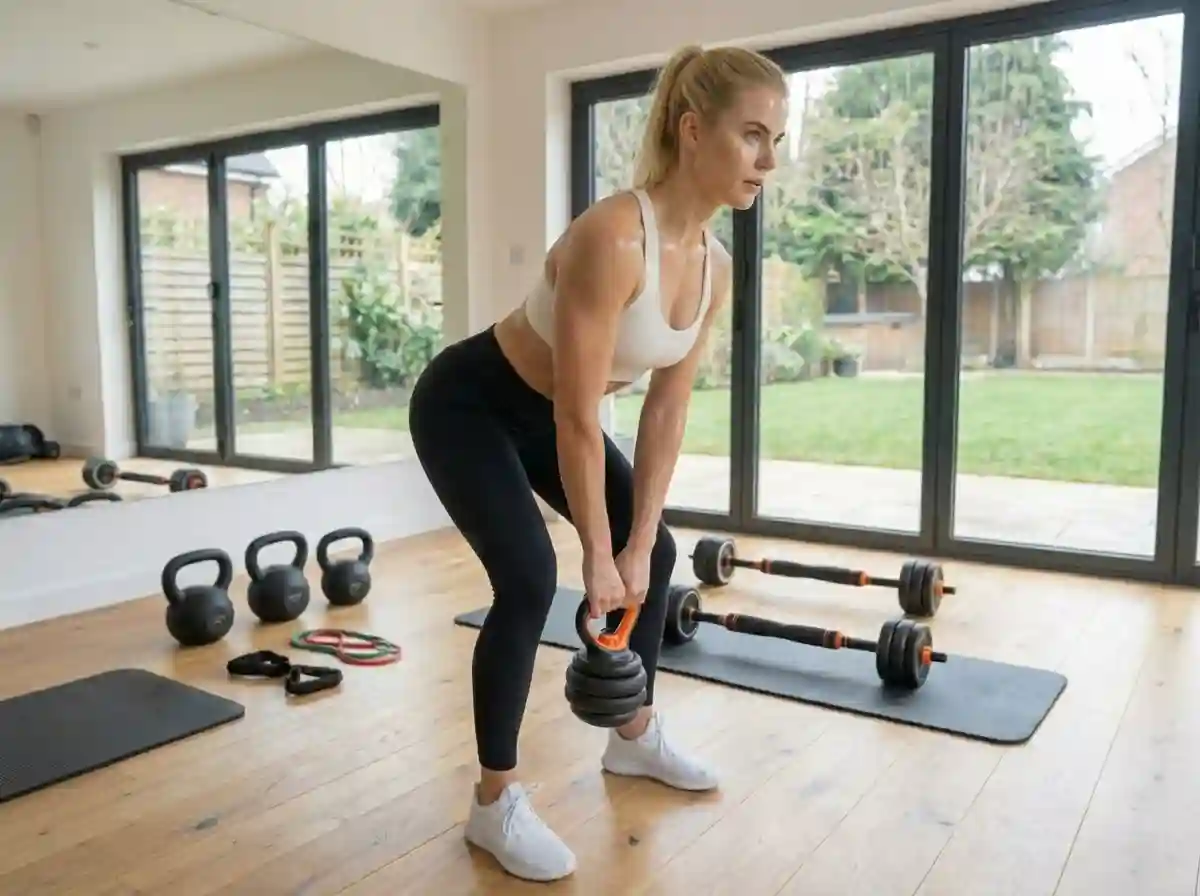
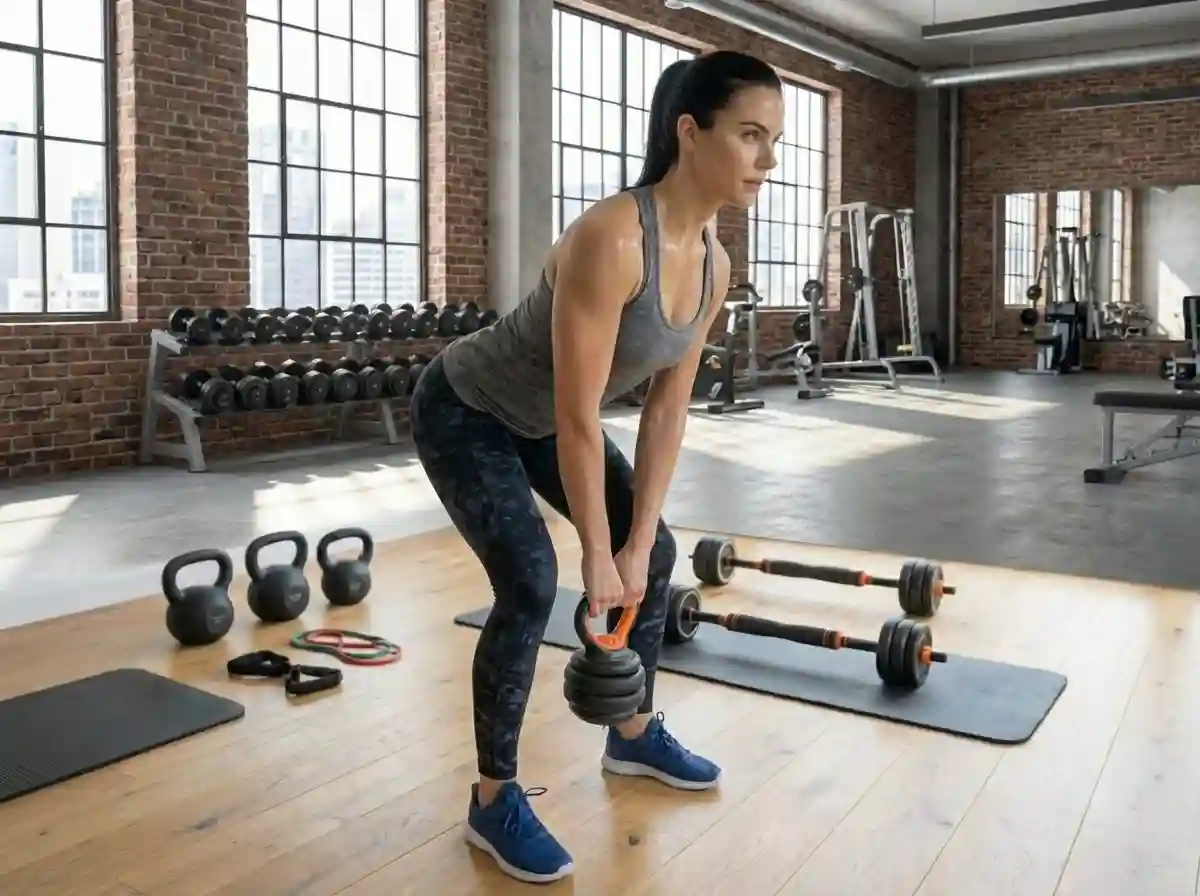
The single most common mistake people make with the kettlebell swing is treating it like a squat with a pendulum attached. It's not. It's a hip hinge — maximal posterior displacement of the pelvis, significant hip flexion, and minimal knee bend. The difference in which muscles carry the load is dramatic.
When you hinge correctly, the primary mechanical burden falls on the gluteus maximus and hamstrings, not the quads. The kettlebell, held at the end of your arms (a long lever), creates a substantial moment arm at the hip joint — your glutes and hamstrings have to work hard to reverse the weight's direction at the bottom.
This is not a slow grind. The swing is ballistic — you're producing high rates of force development (RFD) to accelerate the mass, then essentially letting it float before pulling it back down. That float phase, where the muscles briefly relax, is a signature of efficient athletic movement. You see it in sprinting, jumping, throwing. The swing trains you to express and then reset power quickly.
What the Force Data Actually Shows
Researchers have put athletes on force plates during kettlebell swings, and the numbers are instructive. The exercise generates a unique force-time curve: a rapid spike in both vertical and horizontal force as the lifter reverses the kettlebell at the bottom of the hinge.
| Exercise | Peak Force (N) | Peak Power (W) | Notes |
|---|---|---|---|
| KB Swing (32 kg) | 2,450 ± 310 | 2,680 ± 580 | Comparable to jump squat |
| Back Squat (80% 1RM) | 3,120 ± 420 | 1,050 ± 210 | High force, low velocity |
| Jump Squat (40% 1RM) | 2,210 ± 290 | 3,150 ± 620 | High power, vertical focus |
| Deadlift (1RM) | 4,200 ± 550 | 600 ± 150 | Maximal force, minimal power |
The swing with a 32 kg bell produces roughly 2.5× the power output of a back squat at 80% of 1RM. That's not a marginal difference. And unlike the deadlift — which peaks in force but barely generates power — the swing combines meaningful force and velocity, which is exactly the recipe for power development.
How Load Affects the Equation
One of the more nuanced findings in the research is how kettlebell mass interacts with the variables you actually care about:
| KB Mass | Peak Force (N) | Mean Power (W) | Peak Velocity (m/s) | Net Impulse (N·s) |
|---|---|---|---|---|
| 16 kg | 1,845 ± 195 | 1,420 ± 310 | 3.15 ± 0.35 | 145.2 ± 28.5 |
| 24 kg | 2,115 ± 235 | 1,750 ± 380 | 2.85 ± 0.28 | 210.5 ± 35.1 |
| 32 kg | 2,450 ± 310 | 2,150 ± 450 | 2.42 ± 0.25 | 276.1 ± 45.3 |
Most research points to roughly 28–30% of body weight as the optimal load for maximal power development in the two-handed swing. Too light and you're not driving enough neural adaptation. Too heavy and hip extension velocity tanks, turning a ballistic movement into a slow grind.
The EMG Data: What's Actually Firing and When
Surface electromyography (sEMG) has given us a detailed picture of how the posterior chain activates during the swing. The findings are more specific — and more interesting — than the general "it works your glutes and hamstrings" claim you'll see everywhere.
Gluteus Maximus
The glute max is the primary driver of hip extension. Research by Stuart McGill and colleagues has shown that a standard 16 kg swing elicits peak glute max activation of around 76% MVIC in trained individuals. In women, that number can climb to 82–99% MVIC depending on swing style and load. Peak activation hits at approximately 57% of the swing cycle — the lockout, the "hip snap" — which is why coaches hammer that cue so hard.
Biceps Femoris
Here's the part that surprises most people: the hamstrings activate before the glutes. Specifically, the biceps femoris fires first in both the eccentric and concentric phases. This early activation controls the descent and initiates the explosive reversal. Peak BF activation reaches 79–115% MVIC — comparable to dedicated hamstring exercises like the seated leg curl.
Also notable: the medial hamstrings (semitendinosus) tend to be targeted more than the lateral hamstrings in a standard hip-hinge swing. If you're using swings for hamstring rehabilitation or injury prevention, that asymmetry matters.
Erector Spinae
The spinal extensors operate at around 50% MVIC during a two-handed swing, cycling through rapid bracing and relaxation. In single-handed swings, the contralateral erector spinae activates significantly harder (14–25% higher) to counter the rotational load.
| Muscle | Two-Handed (% MVIC) | Single-Handed (% MVIC) | Peak Timing |
|---|---|---|---|
| Gluteus Maximus | 76.1 ± 36.6% | 81.4 ± 61.3% | 57% — lockout |
| Biceps Femoris | 79.0 ± 53.3% | 82.5 ± 55.1% | 30% — early concentric |
| Gluteus Medius | 70.1 ± 23.6% | 57.4 ± 25.9% | 50–60% — mid-swing |
| Erector Spinae | ~50% | 65–75% (contralateral) | 30% and 100% |
| Rectus Abdominis | 30–40% | 40–60% | 50% — float phase |
Russian vs. American: What the Data Says
The debate between shoulder-height (Russian) and overhead (American) swings tends to generate more heat than it deserves. The mechanical reality is more nuanced.
| Variable | Russian (RKBS) | American (AKBS) | Significant? |
|---|---|---|---|
| Concentric Amplitude (m) | 1.92 ± 0.19 | 2.49 ± 0.22 | Yes (p<0.001) |
| Peak Velocity (m/s) | 4.71 ± 0.82 | 5.43 ± 0.70 | Yes (p<0.001) |
| Peak Momentum (kg·m/s) | 116.39 ± 14.97 | 130.28 ± 16.83 | Yes (p<0.001) |
| Mean Power (W) | 126.96 ± 33.9 | 125.14 ± 27.34 | No (p=0.681) |
| Cycle Duration (s) | 0.73 ± 0.05 | 0.89 ± 0.08 | Yes (p<0.05) |
Mean power is essentially identical between the two styles. The American swing covers more distance with higher peak velocity, but the extra range of motion doesn't translate to greater power output — it just takes longer. The Russian style allows heavier loads, keeps the training stimulus on the posterior chain, and eliminates overhead mobility demands and lumbar compensation risks.
What Happens to Your Spine
Dr. Stuart McGill's work on spinal biomechanics during kettlebell exercises revealed something counterintuitive. A standard 16 kg swing generates roughly 3,200 N of lumbar compression — within normal training parameters. What's unusual is the direction of shear force. Most traditional lifts produce anterior shear. The kettlebell swing produces posterior shear at L4/L5 — the opposite direction.
| Exercise | Compression at L4/L5 (N) | Posterior Shear (N) | Key Response |
|---|---|---|---|
| Standard Swing | 3,195 ± 410 | 185 ± 35 | Rhythmic bracing |
| Kime Swing | 2,960 ± 380 | 267 ± 48 | High oblique activation |
| Swing-to-Snatch | 3,150 ± 450 | 78 ± 22 | Overhead stabilization |
| Bottoms-Up Carry | 1,850 ± 220 | 120 ± 25 | High grip/forearm demand |
This posterior shear profile is one reason some individuals with chronic low back pain report improvement after incorporating swings — especially those whose pain is related to excessive anterior loading from sitting, bending, and conventional lifts. The "Kime" technique — a sharp, ballistic core brace at the top — increases external oblique activation by 101–140% compared to a standard swing.
Beginners vs. Experts: What Changes When You Get Good
Biomechanical analysis consistently identifies the same differences between novice and skilled practitioners:
- Experts hinge ~20° deeper at the hip and use ~15° less knee flexion at the bottom
- Experts achieve ~10° more hip extension at the top
- Experts show a proximal-to-distal activation sequence — hips initiate, then shoulders, then the bell. Beginners often reverse this, pulling with the upper body instead of driving with the hips
The deeper hinge and more complete extension translate directly to greater hip angular velocity — which is where the power comes from. The upper body "helping" in novice swings isn't just a technical flaw; it actively limits power output and redistributes load to areas that shouldn't be primary movers.
Carryover to Athletic Performance
The swing's training effects aren't confined to the gym. The research on transfer to athletic tasks is reasonably strong:
- Vertical jump: Kettlebell swings and explosive deadlifts produce equivalent vertical jump improvements over short training cycles
- Sprinting: The horizontal force component (stronger than most barbell movements) has direct carryover to sprint acceleration mechanics
- Olympic lifting: Six weeks of kettlebell training improved power clean 1RM by ~4.2%
The swing also meets the ACSM's criteria for vigorous-intensity cardiovascular exercise — even 10 minutes of interval swings (35 seconds on, 25 off) can push heart rate above 85% of age-predicted maximum.
Practical Takeaways for Programming
| Goal | Load | Protocol |
|---|---|---|
| Maximal power | ~28–30% bodyweight | 5–10 reps, full recovery between sets |
| Power endurance / conditioning | 20–25% bodyweight | 15–20 reps, 1:1–2:1 rest/work ratio |
| Hamstring focus | Moderate | Active eccentric — pull bell back, don't drop |
| Low back rehab | Light–moderate | Russian style only, qualified supervision required |
Style selection: Russian swing as the default. Progress to American only when overhead mobility is genuinely sufficient and the training goal specifically demands it.
The kettlebell swing has earned its place in serious training programs — not because of marketing, but because the biomechanical data shows it's one of the few tools that simultaneously develops posterior chain strength, explosive power, and cardiovascular capacity in a way that's mechanically distinct from anything else in the toolbox.
Key References
- McGill, S.M. & Marshall, L.W. (2012). Kettlebell swing, snatch, and bottoms-up carry: back and hip muscle activation, motion, and low back loads. Journal of Strength and Conditioning Research
- Lake, J.P. & Lauder, M.A. (2012). Mechanical demands of kettlebell swing exercise. Journal of Strength and Conditioning Research
- Hetzler, R.K. et al. (2012). Effect of load on mechanical and physiological variables during kettlebell swings. Journal of Strength and Conditioning Research
Ready to Train Smarter?
Explore FEIERDUN® equipment — engineered for explosive performance at every fitness level.